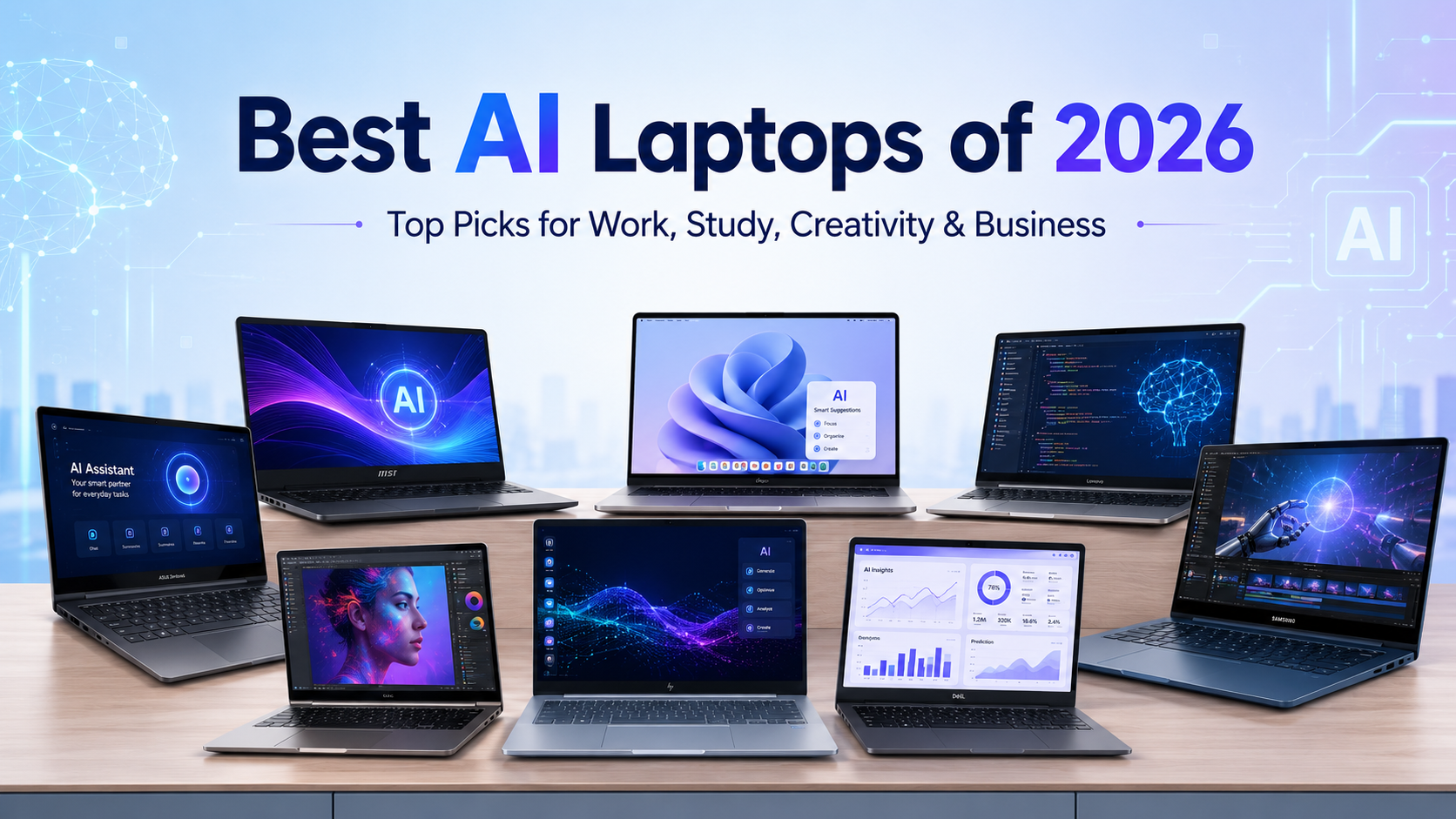
1. Introduction: The 2026 Technology Disruption
The year 2026 marks the most significant technological pivot in over two decades. According to the 2026 State of Marketing Report by HubSpot, 61% of marketers believe the industry is currently weathering its largest disruption in 20 years. This shift is not merely about software updates; it is a fundamental reconfiguration of how we interact with the digital economy.
Choosing a laptop in 2026 is no longer a checklist of legacy hardware specs. To remain viable, your device must be a conduit for “Agentic Commerce”—an era where AI agents autonomously facilitate checkouts and manage complex workflows. As technology and humanity converge, your hardware choice determines whether you are a passive observer or an active driver of this disruption.
2. For Professionals: The “AI-Baseline” Workstation
In the current professional landscape, AI is no longer a differentiator—it is the baseline. With 80% of marketers utilizing AI for content and 75% for media production, a “work laptop” must be defined as an AI-ready powerhouse capable of high-efficiency operationalization.
To manage the “New Marketing Imperative,” professional devices must support:
- Agentic AI Management: Hardware capable of running autonomous AI agents that compare prices and facilitate “zero-click” transactions across retailers.
- Headless Architecture Support: Processing power to manage API-first, flexible stacks that ensure omnichannel consistency across web, mobile, and social touchpoints.
- AI-Powered Workflows: Dedicated silicon to unlock speed and personalization, shifting the burden of automation to the machine while reserving the human lead for high-level creativity.
3. For Students: The Content & Creator Powerhouse
For the modern student, the laptop has evolved into a comprehensive media production hub. Sprout Social data reveals that 49% of Gen Z consumers use TikTok for product discovery, and 46% prefer short-form video formats like Reels and YouTube Shorts.
Beyond research, a student’s device must function as a “Creator Hybrid” to navigate an economy projected to exceed $6.8 trillion in 2026.
The Creator Hybrid Checklist:
- [ ] NPU-Integrated Processor: Essential for real-time AI video masking and Answer Engine Optimization (AEO) to handle natural language queries.
- [ ] GPU-Accelerated Rendering: Required for high-velocity short-form video editing and interactive 3D elements.
- [ ] Low-Latency Networking: Wi-Fi 7 or 6E for seamless “Livestream Shopping” sessions and real-time social commerce.
- [ ] High-Fidelity Audio/Visual: Professional-grade webcams and microphones for “Authentic Storytelling” that cuts through AI-generated noise.
4. For Everyday Use: Trust, Privacy, and Social Shopping
For general use, the priority has shifted toward security and seamless social integration. With 58% of shoppers now buying directly from social media, a personal laptop must act as a secure vault for “Safety of Processing Personal Data.”
In a landscape governed by GDPR and CCPA, poor data handling leads to “disastrous outcomes,” including identity theft and legal liabilities. Everyday users should prioritize:
- Hardware-Level Encryption: To safeguard sensitive attributes and personal data.
- Biometric Security: For frictionless, secure “zero-click” transactional layers during social shopping.
- Privacy-Centric Architecture: User control features that allow for the “right to be forgotten” and transparent data minimization.
5. The 7-Pillar Framework for Selection
Adapt your purchase to the 7 pillars of the 2026 digital landscape:
| Selection Pillar | Hardware Consideration |
| SEO/Visibility | Visual Clarity: High-resolution displays for technical excellence and SGE (Search Generative Experience) monitoring. |
| Content Marketing | GPU/NPU Power: Dedicated AI silicon for media production and high-velocity content scaling. |
| Social Media | Capture Quality: Studio-grade camera/mic arrays for “Human-Led” authentic engagement. |
| Paid Advertising | Wi-Fi 7/6E: Ultra-low latency for precision targeting and real-time bidding on the go. |
| Email/ROI | Input Ergonomics: Tactile, high-durability keyboards for high-volume, personalized communication. |
| Analytics & Data | High-Capacity RAM: 32GB+ for processing GA4, heatmapping, and attribution data. |
| CRO (Conversion) | Interface Speed: Low-latency NVMe storage for managing frictionless, high-speed user experiences. |
6. Conclusion: Scaling with Humanity
In 2026, while AI provides the baseline for efficiency, human-led insights are the primary drivers of revenue and trust. The market is saturated with “average” automated content; distinctiveness is now a competitive necessity.
Do not choose a device based on yesterday’s standards. Choose a machine that empowers your “sharper point of view.” In an AI-flooded world, the right hardware is the one that allows your unique human creativity to scale without losing its soul. Your device should be more than a tool—it should be your edge in an era where technology accelerates opportunity, but only for those with the power to harness it.
Leave a Reply