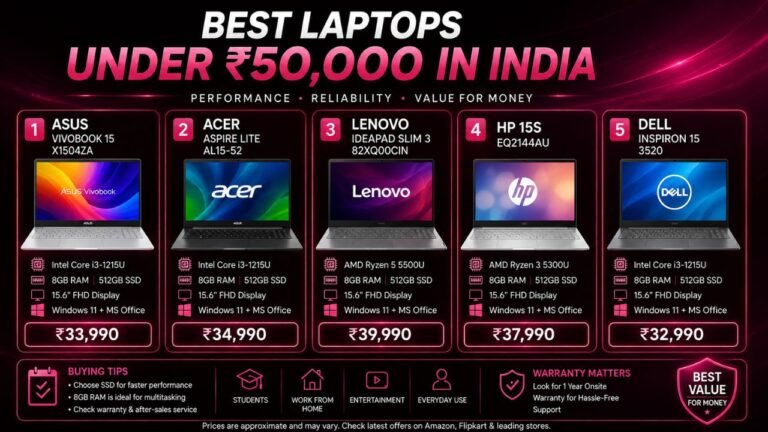
1. Introduction: Navigating Tech Discovery in the Era of Agentic Commerce
AI is the baseline, not the differentiator in the 2026 laptop market. If you are searching for a laptop under ₹50,000 today, you are likely already interacting with “Agentic Commerce.” This shift means AI agents and generative summaries now handle the heavy lifting of product discovery, moving us past the era of manual link-clicking.
To secure the best value, you must master Answer Engine Optimization (AEO). Stop using fragmented keywords like “budget laptop 2026.” Instead, use natural human language queries: “Which laptop under ₹50k offers the best thermal management for 4K video editing?” In this landscape, search engines prioritize content that directly answers user questions. As a savvy buyer, look for manufacturer pages that use clear Q&A formats because AI agents can cite them more accurately and reduce the risk of receiving incorrect specifications.
2. The Core Evaluation Framework: Usefulness over Interactivity
In the ₹50,000 segment, manufacturers often hide compromises behind flashy “interactive” gimmicks. Applying the Bakhtieva Framework (2026) allows you to strip away the marketing noise:
- Ease of Use: Focus on hardware-software synergy. In 2026, this means looking for a “clean” OS experience. Avoid laptops weighed down by manufacturer bloatware that eats into your RAM cycles before you even open a browser.
- Usefulness: Prioritize functional value over “distractive” features. A technical journalist’s advice? Trade the RGB chassis lighting and touch-bars for a 300-nit brightness screen and 16GB of DDR5 RAM. If a feature feels like “entertainment” rather than “utility,” it’s a distraction from the core performance you need.
- Information Flow: This is where you apply “technical cynicism.” Demand transparency. If a brand hides the TDP (Thermal Design Power) or the sRGB color coverage, assume the worst. Real value is found in brands that provide a high quality of technical flow, revealing NPU TOPS and thermal throttling benchmarks upfront.
3. Human-Led Insights: Why Authenticity Matters in a World of AI Content
With 80% of marketing content now AI-generated, “average” is the new standard. As Kieran Flanagan (SVP of Marketing at HubSpot) notes, consumers are increasingly “tuning out brand and AI-generated content” in favor of expert points of view.
When evaluating hardware, seek out Human-Created Content. Hands-on expertise found in gated newsletters or technical podcasts outperforms automated summaries because it captures empathy and real-world failure points. An AI can summarize a spec sheet, but it cannot tell you if a laptop’s hinge will creak after six months of Mumbai’s humidity.
4. The 2026 Social Commerce Factor: Finding Value on Interactive Platforms
Social media is no longer just for discovery; it is a transactional layer. With 46% of shoppers preferring short-form video for product evaluation, platforms like TikTok and Instagram are your primary labs for visual performance proof.
| Discovery Tool | Buying Advantage |
| Shoppable Livestreams | Real-time Q&A; see the laptop handle a stress test live. |
| Creator-Affiliate Hybrids | Instant visual proof of port selection and build quality. |
| Interactive Video | Seamless “in-app” checkout; use this to snag limited-quantity flash sales. |
5. Security and Data Privacy: The New Tech Purchasing Imperative
In 2026, a data breach costs an average of $4.24 million. This isn’t just a corporate problem; it’s a buyer’s risk. Before clicking “buy” on a digital storefront, verify these three privacy imperatives:
- Safety of Processing: Verify that sensitive data like your phone number and UPI ID are handled via strong, encrypted security protocols.
- User Control: You must have the “right to be forgotten.” Ensure the retailer allows you to delete your data post-purchase.
- Transparency: Look for a clear “Statement of Purpose” and Accessible Privacy Policies. Practice Data Minimization: choose retailers that only ask for essential attributes (age/interest) rather than demanding full demographic profiles.
6. Final Checklist: The 7 Pillars of a Strategic Purchase
Use this buyer-centric checklist to ensure your ₹50,000 investment delivers high ROI:
- Visibility: Does the brand have an authoritative presence in technical forums, or just on ad banners?
- Content: Does the product page use a Q&A format to solve real user problems (e.g., “How long does the battery last under heavy NPU load?”)?
- Social Proof: Is there authentic storytelling from verified owners, or just bot-generated five-star reviews?
- Paid Precision: Are the ads you see actually relevant to your specs, or is the brand just wasting budget on “expensive noise”?
- Direct Connection: Does the manufacturer offer a personalized support relationship via email after the sale?
- Analytics: Are the performance claims (battery life, sRGB) measurable and verified by third-party benchmarks?
- CRO (Conversion): Is the storefront “Headless”? You should be able to start a purchase on a TikTok livestream and finish it on the website without re-entering your data—a frictionless omnichannel experience.
7. Conclusion: Building Trust in a Crowded Market
The best laptop under ₹50,000 is not the one with the loudest AI-generated campaign. It is the one backed by a brand with a Clear POV and Credibility. In 2026, growth and trust are driven by distinctiveness and relevance, not short-term clicks. Focus on technical transparency and human expertise to ensure your purchase is both strategic and secure.